Silly instruction sheet

Today I saw the silliest instruction sheet I’ve seen in a long time. The instructions where inside of a new travel mug I got. Most of the items in the instructions are OK, although mostly unnecessary for anyone with 1/4 of a brain. But, some very odd warning items jumped out at me.

In the how to use section:
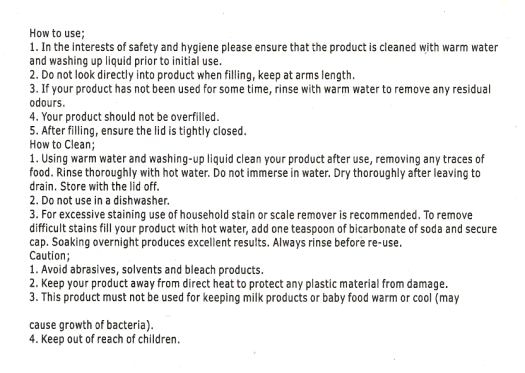
2. Do not look directly into product when filling, keep at arms length.
….
4. Your product should not be overfilled.

They can’t be serious, does it have a tendency to explode or what? Should I put on safety glasses before I fill it up. 😉 How else am I supposed to avoid over filling if I can’t look directly into the mug. Maybe they want me to use a mirror periscope while filling. 🙂

Then in the caution section I see:
4. Keep out of reach of children.

Huh, don’t let children near a travel mug, are they going to get locked inside?

Here’s the whole instruction sheet:scan0001-1

Article the third

The title of this post may seem odd considering it’s my 2nd post for the Blog Against Theocracy blogswarm and the topic is a piece of the 1st Amendment . However, every time I look up from my main PC monitor I see a reproduction of the Bill of Rights which says:

“Article the third…… Congress shall make no law respecting an establishment of religion, or prohibiting the free exercise thereof; or abridging the freedom of speech, or of the press; or the right of the people peaceably to assemble, and to petition the Government for a redress of grievances.”

I just couldn’t resist using the original designation as the title of this post. The last post showed the long history of the concept of absolute freedom of religion and conscience as espoused by Roger Williams and others in the 17th century. While many people believe that the freedom of religion the founders of the USA meant was freedom to choose a form of Christianity this is clearly not true of Roger Williams and his followers. Their definition of freedom of religion clearly means total freedom including non-belief and is clearly seen in this part of Williams 1644 book The Bloudy Tenent of Persecution .

Sixthly, it is the will and command of God that (since the coming of his Son the Lord Jesus) a permission of the most paganish, Jewish, Turkish, or antichristian consciences and worships, be granted to all men in all nations and countries; and they are only to be fought against with that sword which is only (in soul matters) able to conquer, to wit, the sword of God’s Spirit, the Word of God.

So by the time of the founding of this country there is already a long history of citizens who are determined to avoid an American theocracy. At the start of the American Revolution the Virginia Convention of Delegates adopted George Mason’s Virginia Declaration of Rights containing this clause on freedom of religion.

XVI That religion, or the duty which we owe to our Creator and the manner of discharging it, can be directed by reason and conviction, not by force or violence; and therefore, all men are equally entitled to the free exercise of religion, according to the dictates of conscience; and that it is the mutual duty of all to practice Christian forbearance, love, and charity towards each other.

During the ratification process of the US Constitution the question of guaranteed freedom of religion was debated heavily. Many of the colonies were slow to ratify and beginning with New Hampshire they started adding freedom of religion clauses to their ratification documents as desired amendments.
New Hampshire June 21, 1788 – “Congress shall make no Laws touching Religion, or to infringe the rights of Conscience”.
Virginia June 26, 1788 – “That religion or the duty which we owe to our Creator, and the manner of discharging it can be directed only by reason and conviction, not by force or violence, and therefore all men have an equal, natural and unalienable right to the free exercise of religion according to the dictates of conscience, and that no particular religious sect or society ought to be favored or established by Law in preference to others.”
New York July 26, 1788 – “That the People have an equal, natural and unalienable right, freely and peaceably to Exercise their Religion according to the dictates of Conscience, and that no Religious Sect or Society ought to be favored or established by Law in preference of others.”
North Carolina November 21, 1789 – same as Virginia.
Rhode Island May 29, 1790 – same as Virginia.

All my research over the past week has reinforced my beliefs in the meaning of the First Amendments’ religion clauses. There needs to be absolute freedom for all US citizens to believe in any religion they want or to not believe in any religion at all. Citizens must also tolerate the beliefs of all other citizens and the government should neither help nor hinder any particular beliefs. CFI has published an excellent position paper titled, “THE TRUE MEANING OF THE ESTABLISHMENT CLAUSE“(PDF), which I highly recommend. It provides a good deal of information on the opinions of Jefferson and Madison which is why I didn’t write about those influential founding fathers.

For reference and further reading:
First Freedom First
Exploring First Amendment Law
Illinois First Amendment Center
The U.S. Constitution Online
Wikipedia – United States Constitution
Wikipedia – United States Bill of Rights

For a humorous look at the problems with theocracy and fundementalism, I highly recommend Moral Orel on Cartoon Networks’ Adult Swim .

Tags:

Freedom of Religion

I decided to participate in this weekends blogswarm, the topic is the separation of church and state. This blogswarm was created by Blue Gal, the blogswarm web site is here .

From a very early age my Dad taught me about the absolute necessity of freedom of religion and the separation of church and state. You see, my Dad was an American Baptist Minister and these are core principals(PDF) of that branch of Christianity. The foundation for this tradition is the life and teachings of Roger Williams (1603–1684).

Roger Williams developed a strict belief in the right of all persons to absolute freedom of conscience, especially with respect to religion. His views put him in opposition to the theocracy of England so, in 1630 he left for the New England colonies arriving at Boston in 1631. He quickly realized that the early New England settlers where simply creating a theocracy using their own brand of religion. Williams taught and preached on his philosophy of liberty of conscience bringing him into conflict with the authorities of the Massachusetts Bay Colony. During this time he visited with the native peoples of the area frequently even learning their languages which won him the respect and friendship of many tribes. Unlike most people of the colony, Williams respected the American Indians’ right to freedom of religion and their ownership of the land. He felt strongly that land in the colony must be legally purchased from the native peoples and never just be taken from them.

In 1635 the General court of the Massachusetts brought charges against Roger Williams for teaching his philosophy of absolute liberty of conscience and freedom of religion. He never contested the charges against him but freely admitted his belief highlighted by this quote “No one should be bound to maintain a worship against his own consent”. In October 1635 the General court of the Massachusetts colony banished Roger Williams from Massachusetts for refusing to retract his statements apposing the religious laws of the court.

Williams left Massachusetts in 1636 and settled on land he purchased from the Indians on Narragansett bay. He along with a dozen or so followers established Providence Plantations now known as the city of Providence. A few years later, in 1639, John Clarke arrived on Rhode Island and founded the city of Newport also on the principles of absolute freedom of religion and conscience. Clarke and Williams traveled to England in 1652 to secure a charter from King Charles II. Clarke authored the Charter of Rhode Island and Providence Plantations which was signed July 15, 1663 by the King. This established the first government in the Americas dedicated to the principals of freedom of religion and Rhode Island followed it as the basis for government until 1842.

By the time of the American Revolution, Williams and Clarke where long deceased. However their philosophy of religious freedom, tolerance and liberty of conscience was influential in the actions of the leaders of the revolution. The State of Rhode Island and Providence Plantations was a model of religious liberty for all the colonies. The states adherence to these principals led to the founding of the first Jewish Synagogue in the colonies, Touro Synagogue established in 1763 in the city of Newport. These ideas of freedom and liberty where widely held by intellectuals at the time of the revolution and are embodied in the Declaration of Independence.

We hold these truths to be self-evident:
That all men are created equal; that they are endowed by their Creator with certain unalienable rights; that among these are life, liberty, and the pursuit of happiness;….

Although the belief in the absolute right of freedom of religion and conscience was common among many intellectuals of the era, it was not included in the Constitution of the United States. This was due to many citizens still desiring their own form of theocracy based on the teachings of their religious leaders. This brings me to the ratification of the Constitution and the absolutely essential Bill of Rights that I will write about in another post tomorrow.

For reference and further reading:

Books:
Memoir of Roger Williams, James D.Knowles, 1834
Roger Williams The Pioneer of Religious Liberty, Oscar S. Straus, 1894
An Historical Discourse on the Civil and Religious Affairs of the Colony of Rhode-Island, John Callender, 1739
History of Rhode Island, Edward Peterson, 1853
Records Of The Colony Of Rhode Island And Providence Plantations In New England, John Russel Barltett, 1859

Web Sites and Articles:
The Avalon Project at Yale Law School
Wikipedia, History of Rhode Island
Roger Williams Champion of Liberty
Newport Notables Dr. John Clarke

Tags:

Thought provocing article

I read an interesting article in the Telegraph newspaper online this evening. The first comment after the article showed an all to common lack of understanding of scientific proof.

Andy Cunningham wrote “When I realised there was no Father Christmas, I realised that there can’t be a god, either.”

I should like to know how you ‘realised’ this. The two are completely different, in that it can easily be proved that Father Christmas is not real, yet nobody has offered any strong evidence that God does not exist.

Following scientific methods and principles, you can not prove that either Father Christmas or God don’t exist any more than you can prove that reindeer don’t fly. To prove that reindeer don’t fly or Father Christmas doesn’t exist he will have to use thinking that would also lead to proving God doesn’t exist. This is why the religion I was raised with had no problem with science, science could never disprove the existence of anything supernatural including God.
It is not satisfying to many people but it’s an unavoidable reality that science can’t disprove the existence of the supernatural. The existence of the supernatural is provable using scientific methods but so far it hasn’t happened. This isn’t for lack of trying mind you, much effort and money has been expended over the past hundred plus years trying. There just hasn’t been any success in the research.

When you need some stats, get em here

The next time you need some authoritative looking statistics to back up your arguments visit eSolutionsData.

eSolutionsData relies on people not reading the fine-print to get away with showing seemingly authoritative, yet totally “customized” statistics. Impress everyone in the meeting by proving your point not only makes common sense, but is also backed up by a statistic printed from a real website.

Using their technique you can create convincing looking statistics that sadly I think many people will believe.