Hurry up, only a few days left!

OK, what are you waiting for? Get your butt over to Stranger Fruit and click the “donate to my challenge” button on the left just below John’s picture.

I finally got my year end profit sharing check so I made my donation tonight. If you don’t know about DonorsChoose, see my other post on this fine organization or check out John’s posts about the organization and the ScienceBlogs challenges. The challenge ends this month so GO TO Stranger Fruit AND HELP US GET TO THE GOAL, NOW!

P.S. If you stumble on this post after the challenge ends, simply go to DonorsChoose and pick a project yourself.

Please don't avoid vaccinations

Orac pointed me to this story by The Associated Press. Please follow your Doctors advice and vaccinate when appropriate. We don’t want to have an increase in stories like these:

Outbreak of measles among Christian Science students – Missouri and Illinois, 1994

The Largest Outbreak of Measles in the United States during 1999 (PDF)

JAMA — Measles Outbreak in a Boarding School–Pennsylvania, 2003

NEJM — Implications of a 2005 Measles Outbreak in Indiana for Sustained Elimination of Measles in the United States

NewsDaily: Science — Measles outbreak reported at Mich. school

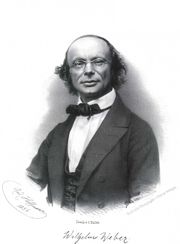
Happy Birthday Wilhelm Weber

Today, October the 24th, is the birthday of Wilhelm Eduard Weber. He was born at Wittenberg, Germany in 1804. I don’t have time to write more about him so I’ll try to write a more detailed post for his birthday next year.

The SI unit of magnetic flux is named the weber to honor his work.

Wilhelm Eduard Weber II

More information:
Wilhelm Eduard Weber – Wikipedia
The Virtual Laboratory People
Weber biography
Encyclopedia of Earth

Some of his books at Google Books (not in English so I can’t read them)
Elektrodynamische Maassbestimmungen
Wilhelm Weber’s Werke

Silence of the Bees on PBS

This sounds like a great season opener for Nature this Sunday night, Silence of the Bees.

The Season 26 opener probes colony collapse disorder the dramatic loss of honeybees in North America and Europe. The honeybee is responsible (via pollination) for one of every three bites of food people eat. Included: long-term ramifications.

The PBS Pressroom has more information and some photos from the show. If you click a picture you will get a new window with a bigger image and a button to download a high resolution version. However, the download requires registration showing you are part of the media. Well, I found that if you just click the picture in the pop-up window, instead of the download button, you get the high resolution image without registration.

Over at ENN they have a good article about the show. I wonder if Bug Girl has heard about this show.

Cold Electricity?

On a mail list the other day, somebody posted links to cold electricity videos on Youtube.

Part 1:
http://www.youtube.com/watch?v=wVSSmVg5voo
<snip>
Homepage:
http://www.stifflerscientific.com/

The one mail list reply was funny:

> Part 1:
> http://www.youtube.com/watch?v=wVSSmVg5voo

“believe it of not”

(misspelling from the video)

Wow, RF works differently than DC!

Exactly, read the description of the lab where the experiments are carried out.

Dr. Ronald Stiffler
Laboratory & Environment
Our lab is located in a bioresearch facility build in the mid-nineties. The lab was not constructed with RF or sensitive electronics work in mind, it therefore has no RF shielding or integral grounding bus bars. The lab is located in close proximity to a 50kw AM transmitter operating on a frequency of 1520kHz. Additionally there are high RF levels from an FM radio station in range of 98mHz.

Gee I wonder if the large amount of ambient RF energy at the lab has anything to do with cold electricity. While it is interesting to capture and use the energy from RF transmissions (e.g. crystal radio, RFID tag) it isn’t going to power your house without exceeding safe exposure limits.

Some more links for your entertainment, “cold electricity” – Google Search

A real test of super speaker cables, maybe not

I read in Swift that one of the outrageously expensive sets of speaker wires where going to submit to a real test. There is no rocket science involved in determining if a person can hear a difference between audio products. The ABX Double Blind Comparator System isn’t exactly new technology and when used in a properly controlled test yields excellent results. The problem is that most manufacturers don’t seem to want to do good tests , instead they depend on reviewers and not necessarily applicable technical measurements.

The next week I read about more developments in the process and it was looking like the people making the claim for the big money cable where backing out. However the next section of Swift gave me hope this would go forward. Randi had done something I hadn’t seen before, he changed the wording of his challenge rules to address the complaints of the reviewer, Michael Fremer.

To those readers who are unfamiliar with the JREF challenge here’s a few important points about it. People often make claims for things that have no plausible scientific explanation. The JREF has put up 1 million dollars US as a prize for any person who has made such a claim, has gotten the claim publicly known via the media and can demonstrate the affect to the JREF. The claimant doesn’t have to explain how anything works all they have to do is show that it works. Both the claimant and the JREF have to agree ahead of time on a test that demonstrates the claim. If the claimant passes the agreed upon test the JREF hands over the prize.

For the claims made by this audio reviewer this should be a very simple and straight forward test. The claim is that the reviewer can reliably tell the difference between the ultra-expensive Pear speaker wire and normally priced speaker wire. A simple controlled double blind listening test will be all that is needed to decide the matter. So if the reviewer and manufacturer are truly sincere about their extraordinary claim they will now go ahead and start discussing a simple test.

Sadly this post, BLAKE WITHDRAWS, has just gone up at the JREF. The manufacturer is pulling out before even hammering out a simple test procedure. This says to me that the manufacturer isn’t all that certain of their claim.

Some more reading about audio cables:
The Truth About Cables – AxiomAudio
Interconnect and speaker cable whitepaper
Speaker Cables from Blue Jeans Cable

From Audioholics Home Theater Reviews and News:
Un-Sound Advice About Cables
Top Ten Signs an Audio Cable Vendor is Selling You Snake Oil
AudioQuest Responds to Top 10 Snake Oil Article
Thiel Audio Interview on Cables
Cable Distortion and Dielectric Biasing Debunked
Skin Effect Relevance in Speaker Cables
Speaker Cable Face Off 1
Speaker Cable Reviews – Faceoff 2
Speaker Cable Faceoff 3

Why we need net neutrality

Two posts at the Electronic Frontier Foundation (EFF) appear to confirm what many have suspected.

EFF tests agree with AP: Comcast is forging packets to interfere with user traffic

Comcast keeps telling its users that the problems they’re seeing are not its fault. It’s time for Comcast to come clean about what it’s doing and take its users’ reports seriously.

Comcast is also Jamming Gnutella (and Lotus Notes?)

When an ISP starts arbitrarily zapping some of the protocols that its customers use, they instantly endanger the cascade of innovation that the Internet has enabled. Before this kind of traffic jamming, anybody — huge businesses, small start-ups, college students and children in their bedrooms — could build new, innovative protocols on top of the Internet’s TCP/IP platform.

If this type of conduct is allowed to continue, many innovators will have to get active assistance from an ISP in order to have their protocols allowed through the ISP’s web of spoofing and forgery. Technologies like BitTorrent and Joost, which are used to distribute licensed movies and are in direct competition with Comcast’s cable TV services, will be at Comcast’s mercy.

It should also be remembered that in many parts of the United States, Comcast is a duopoly or even a monopoly provider of broadband Internet access. Competition might offer some protection against packet-forging ISPs, but under current market conditions, we can’t depend on it.

The last paragraph is the big problem here, with most citizens having little or no choice in ISP’s I think we need Network neutrality in the United States. If we ever get to a point in the US where most citizens have three or more choices in provider then it won’t matter if one or even two ISP’s are interfering with their customers usage.

Cell Phone Jammer Foolishness

Last weeks edition of The McLaughlin Group had the stupidest debate ever.

Chatter Zapper.

Is it a new wave of technology, or is it an anti-wave? They’re called cell phone jammers, capable of voiding any conversation within 20 feet. This combative technology has been called “revenge tech” or “design noir” or “annoyance tech.”

We’ve all been there. You’re sitting on a sold-out train, a crowded bus. It starts with a cell phone ring, some zany, cacophonous sound. Then the person sitting next to you picks up her cell phone. The agony begins; first the retelling of her day, then it is a round of “He said, she said,” then what’s for dinner.

Unobtrusively you reach over and take out your “revenge tech” device — zap. That takes care of that.

I think it’s a pseudo-problem. It’s a pseudo- problem, because technology will now devise a jam-proof telephone or the chatter will not work.
-John McLaughlin

The reason I call this the stupidest debate ever on the show is that jammers are illegal, period. They have been illegal my whole lifetime and they will remain illegal as long as humans want to have usable radio technology. This is not a new technology, as long as there has been radio there has been radio jamming technology. They are confusing a new product with a new technology and ignoring the reality of the FCC rules.

In case you don’t think jammers will get you into deep trouble, here’s the FCC penalty.

Fines for a first offense can range as high as $11,000 for each violation or imprisonment for up to one year, and the device used may also be seized and forfeited to the U.S. government.

For more information and the rules for other countries see this Wikipedia article.

**** UPDATE ****

More information at this newer post

Copyright and License Primer

Recently a case involving software licensing and copyright was discussed on an engineering list. Reading the discussion it became clear to me that it is likely that a majority of people don’t know how copyright and licensing go together. So I thought I’d write a brief primer on the basics of copyright in the 21st century. The particular case in that article illustrates how the wrong choice of license can lead to the loss of some rights that the copyright holder did not intend.

But I’m getting way ahead of myself here, let me start with the basics. First a disclaimer, I am absolutely, positively, not a lawyer. If you have any doubt about any copyright issue that could cost you money consult a copyright lawyer. Second point, I only know about US copyrights, the copyright laws in other countries may be very different. Final point, in this post I’ll be using the terms work and works to indicate any writing, painting, photo, video, music, graphics, software and other types of creative output that is protected by copyright law.

For readers closing in on 50 years old like me or, already past it, I’ll start with how it was before 1978. When I first learned about it the law of the USA was the Copyright Act of 1909. This law specified that copyright was something you had to intentionally place on works if you wanted protection. If you distributed a work without attaching a copyright notice and filing for copyright protection the work was considered public domain. With the adoption of the 1976 Copyright Act, which went into effect in 1978, this situation was reversed. Since 1978 any work a person creates receives full copyright protection immediately without any filing or adding of notices. This means that even a finger paint drawing a three year old creates is automatically protected as a copyrighted work of the three year old the moment it is created.

This gives us the two ends of the copyright spectrum, fully protected and public domain. Public domain works can be used in any way by any person with no restrictions. This means that if someone wants to they can take your public domain work and sell it for money without giving you any credit or money. Full copyright protection prevents everyone from doing almost anything with the work unless they previously were granted permission by the works creator. There is an exception to this known as “fair use” that does give some limited usage rights to critics, reviewers, buyers of the work and others. Fair use is a complicated topic that I don’t have time to cover in this post, see the Wikipedia article for more information.

Often the two ends of the spectrum don’t provide a content creator with a usable option. Putting your work in the public domain makes it difficult to earn a living from your works. Enforcing full copyright on your work severely limits your distribution options because you need to individually grant rights to your customers. When you want to retain control of your works but not burden yourself and your customers with individually granting rights, the solution is to apply a license to the work.

A license for a copyrighted work is a way to take some rights away from the copyright holder and give those rights to the customer. An example of a right most software companies and developers want to give their customers is the right to make archival copies for backup purposes. Without a license granting this right it could be a violation of copyright law for your customer to make a backup copy of the CD you gave them when you sold them the software. (Note fair use doctrine may give some archiving rights to the customer)

You should put a good deal of thought into choosing a license for your works because the wrong license could turn into a big problem. You can create your own license with the help of a copyright lawyer and this is what big businesses usually do. However the costs can be large and if there is a mistake in the license you could lose some of the rights you meant to retain. So, for individuals and small businesses the best solution may be one of the pre-made licenses that are freely available. The Free Software Foundation created and maintains the GNU General Public License (GPL) for software. While this is an excellent license created by some great legal minds it is very restrictive and may not be what you want. So other licenses have been developed such as the LGPL, BSD, Apache and others. For non-software works until recently there were not many choices other than full protection and public domain release. Thankfully the Center for the Public Domain recognized this need and has created the Creative Commons licenses for non-software works.

For more information see:
U.S. Copyright Office
Copyright Law
A brief intro to copyright
10 Big Myths about copyright explained
Blogroll update

Rob Knop of Galactic Interactions has posted that he is closing down his blog. I will miss his contributions to teaching an astronomy newbie like me about some of the coolest discoveries in the field. I will also miss reading his perspective on other issues that so often made me think more deeply about the issue. Farewell Rob and I wish you all the best in your endeavors.

There is some consolation in knowing that Phil will still be giving me great information on astronomy and that I now have room to add someone else to my RSS reader and Blogroll.

Who should I add? That’s a tough decision, there are more excellent blogs out there than I can possibly keep up with. While my inclination was to add a science blog to replace the science blog that is gone, PZ pointed me to a post today that really struck a cord with me.

The blogger who I’m adding is Greta Christina who I have read other excellent posts by in the past including this excellent post that was part of the recent Skeptics Circle. Another earlier post, Short Memories: AIDS Denialism and Vaccine Resistance, had also impressed me with her thoughtful writing and humor.

The post from Greta that I read today, Atheists and Anger, I found very informative.

I get angry when advice columnists tell their troubled letter-writers to talk to their priest or minister or rabbi… when there is absolutely no legal requirement that a religious leader have any sort of training in counseling or therapy.

And I get angry when religious leaders offer counseling and advice to troubled people — sex advice, relationship advice, advice on depression and stress, etc. — not based on any evidence about what actually does and does not work in people’s brains and lives, but on the basis of what their religious doctrine tells them God wants for us.

This really struck a chord with me because my Dad felt the same way as Greta and taught me to see the truth in this position. As I’ve written previously, my Dad was an American Baptist Minister the sect of Baptists who teach the absolute necessity of complete freedom of religion and equal rights with tolerance for all (ref. Roger Williams, Martin Luther King Jr.). He always taught everyone that mental and physical illness need to be addressed by medical and mental health professionals not religious professionals. In fact he told me that both times he moved on to new churches it was mainly due to church members too often trying to use him as a free substitute for mental health professionals. My Dad felt his proper role was to give advice on issues of faith and anyone who asked for help with non-faith issues he tried as hard as possible to get them to go to an appropriate professional.