I have good news and bad news, first the good news. James Burke’s wonderful documentary series The Day the Universe Changed is finally becoming available at a reasonable price. Until now the only way to buy it was at $80 each for the ten DVD’s of the series that’s right $800US (although the Discovery Education Store sells the ten episode set for only $750US). Well on 1/27/2009 the complete 10 episode series will be shipping for $150US from PBS in a 5 DVD box set (you can pre-order now). Not only will you save a big wad of cash but you’ll be helping support PBS (NOVA, Nature, etc.). PBS also has Connections: 1 and Connections: 2 available as box sets at the $150US price in stock for immediate shipping. Also of note to Netflix subscribers is the availability of Connections 1, 2 & 3 right now and TDTUC will be available soon.
Now the bad news, the JamesBurkeFan YouTube channel is gone, he is protesting the copyright related takedown of another YouTube channel he was working on as RichardFeynmanFan. He sent me an email with permission to post it so, I’ll let him explain this in his own words.
This refers to “former” YouTube user “JamesBurkeFan”, which is (or was) myself. I should like to say no request was made to me to take down that channel due to any copyright issue. Nobody contacted me, and I had even been told that Mr. Burke was well aware of the existence of the channel which promoted his views and ideas without any advertising or monetary benefit to myself. Originally I had mentioned on the page that TDTUC was not available for sale to private individuals. This has changed and I was delighted to find out about it, and immediately posted a link to the purchase page on the main channel page.
I took this channel down willingly (and with much sadness) in protest for the takedown of another channel I was building in dedication to Richard Feynman. That channel was another purely educational channel which took the Feynman lectures and combined the audio with clips from the lecture notes making them far easier to understand. I made a pact with myself essentially linking the two channel’s existences (though I pretended to be two different people).
After much correspondence with the complaining party (Michael A. Gottlieb) who was really complaining on behalf of Addison-Wesley publishers (aka. Caltech*), an agreement could not be reached and the site (together with it’s fundamental [and I think novel] idea) was destroyed.
Of course YouTube and my subscribers will not know why the channel was closed. However the awareness raised by it (I have many emails and messages to verify this) brought Mr. Burke to many young people who would otherwise have never heard of him. Additionally, I believe the channel indirectly encouraged the ultimate publication of TDTUC in DVD format for sale to the general public. That was the main goal anyway and I’m glad if in some small way I helped to cause it’s realization.
Sincerely,
– Alan Carre [aka JamesBurkeFan & RichardFeynmanFan]
——————
*that was meant as a joke
It’s too bad that a copyright holder would do this but it is their right. Personally I think Mr. Burkes way of acting is the right way, let the material stay up on the web as long as the poster is not trying to profit from the work and the posting is meant for global public education. But that is a decision only a copyright holder and their attorneys can make, obviously Addison-Wesley doesn’t feel this way. While I never got to see any of Alan’s work on The Feynman Lectures it sure seems like it would have been very helpful in making them easier to understand for the general public. Again personally, I think it could have driven sales of the books and audio of the lectures to the general public but then again, I may be wrong and it could have hurt Addison-Wesley by lowering sales. I also think it is too bad that Alan felt the need to take down the James Burke videos but hey, just like Addison-Wesley’s decision, it is solely his decision to make.
Somewhat related to all this, Blake Stacey of Science After Sunclipse had pointed me to Feynman’s “The Character of Physical Law – Messenger Lectures” series on Google Video last year. Checking to see if I could link to those as a consolation prize for my couple of readers, I see those videos have been taken down too.
*** UPDATE July 18. 2009 ***
Alan has sent me some exciting new information, the Feynman lectures have been purchased by Bill Gates and are being put online for free! You can read more about the story at this article from the NY Times.

 Today is the birthday of Count Alessandro Giuseppe Antonio Anastasio Volta. He was born February 18, 1745 in Como, Lombardy, Italy to Filippo Volta and Maria Maddalena Inzaghi. Volta became the first professor of physics at the University of Pavia in 1779 and held that position for much of his adult life. In March 1800 Volta announced his invention of the voltaic pile, the first electric battery. In recognition of Volta’s scientific contributions, the SI unit for electric potential difference (aka, electromotive force) was named the volt in 1881.

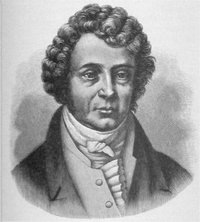 André-Marie Ampère was born in Lyon, France on January 20th, 1775. He was a physicist, mathematician, chemist and natural philosopher who made significant contributions in all these fields. Ampere’s work in understanding electromagnetism are recognized by naming the SI unit of electric current the
  Paul Hutchinson's Blog