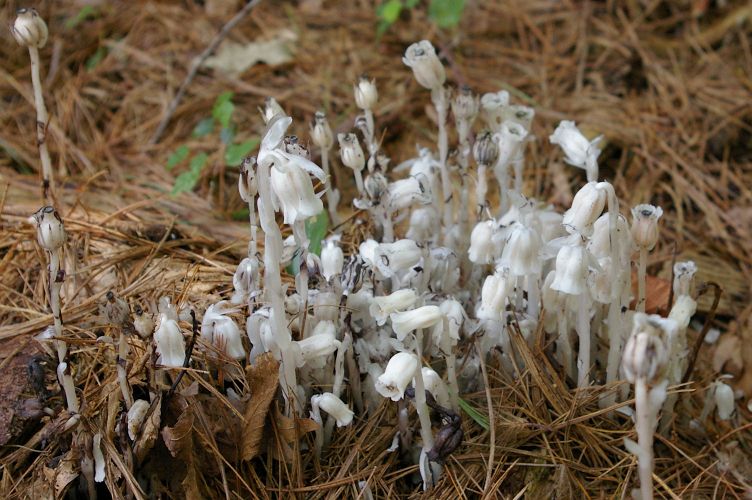
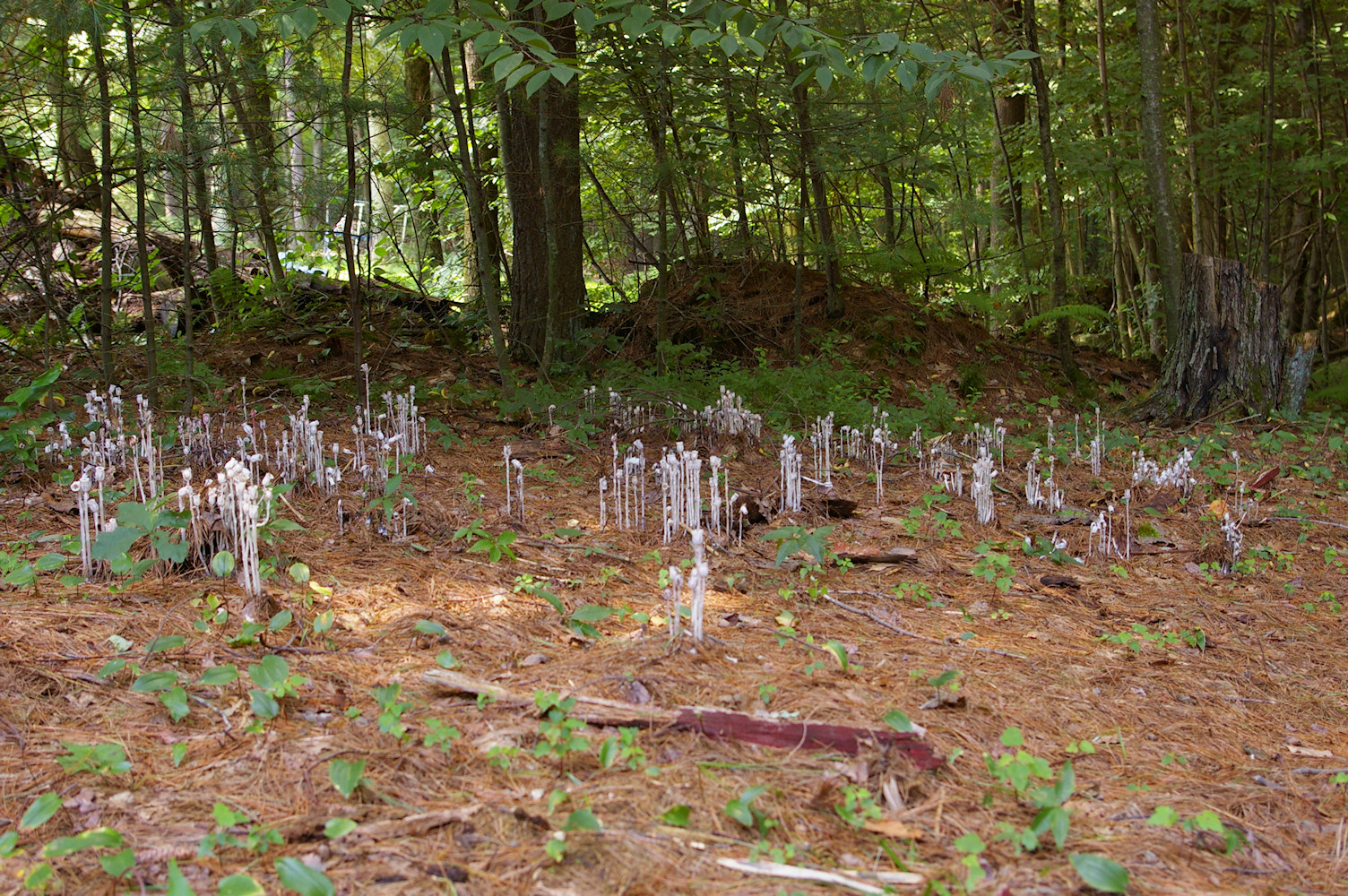
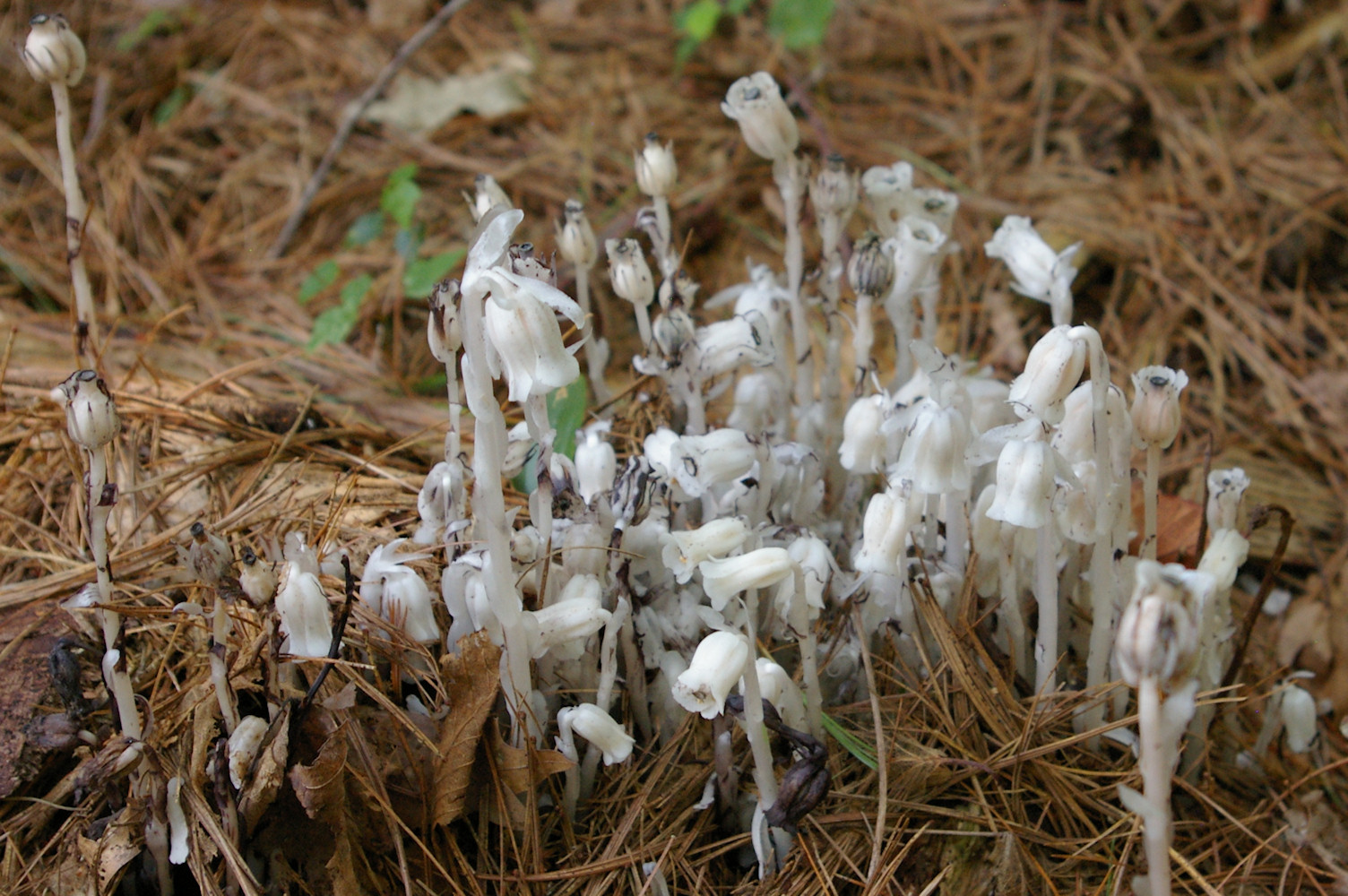
Indian Pipes, Corpse Plants or Ghost Plants that is, on August third my sister was looking out the kitchen window to the woods bordering the back yard and called me to check out an unusual sight. (Click images for larger versions)

Wow! Over 400 Indian Pipes, (Monotropa uniflora) were growing in a 2 square meter area. I’ve seen this plant hundreds of times out in the woods but never more than a dozen or two in one place. With such an unusual natural event I had to take a whole bunch of photos.

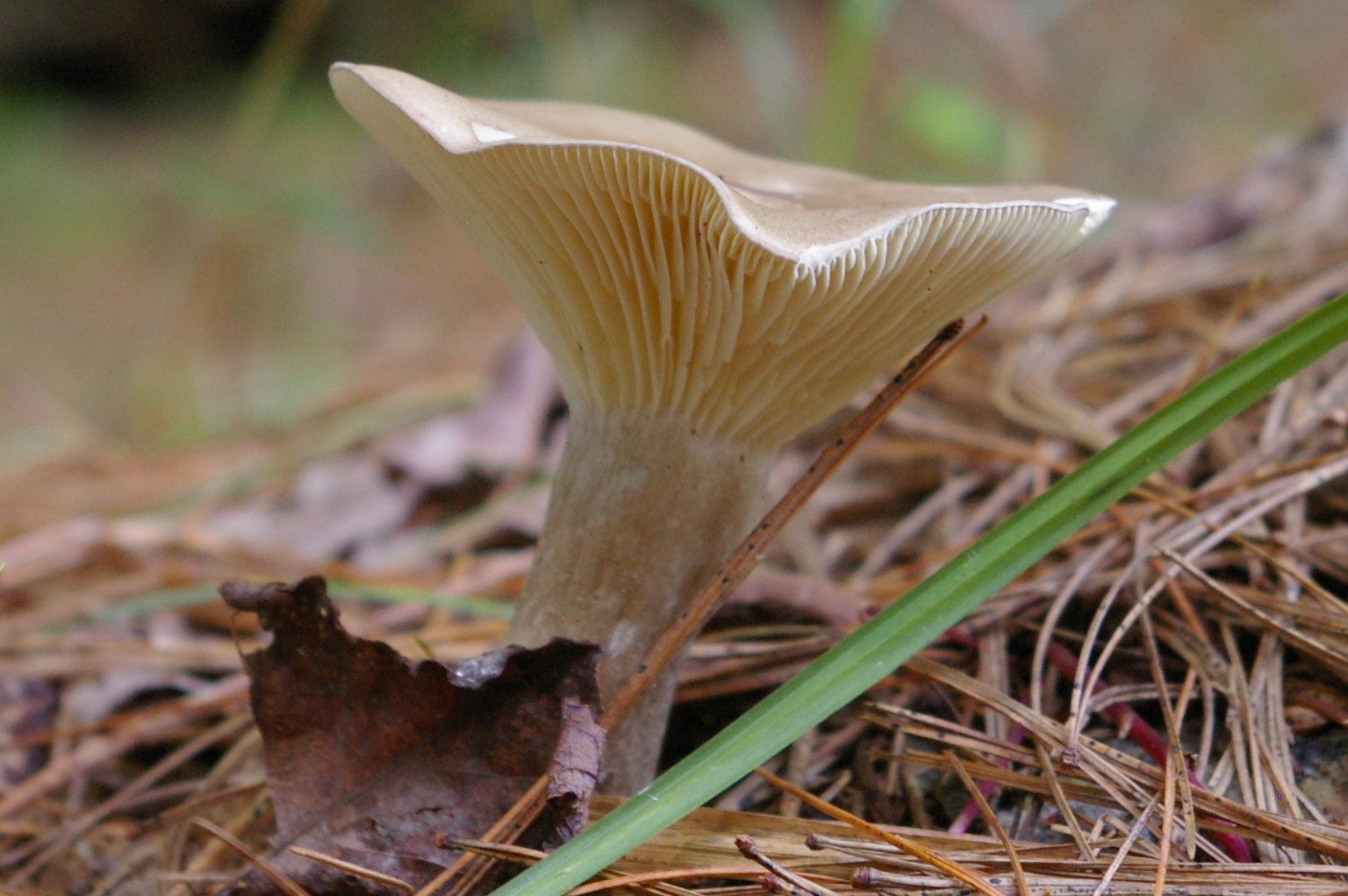
Nearby the Indian Pipes, I spotted this nicely posed mushroom. My best guess at an identification is a Common Funnel Cap (Clitocybe gibba).

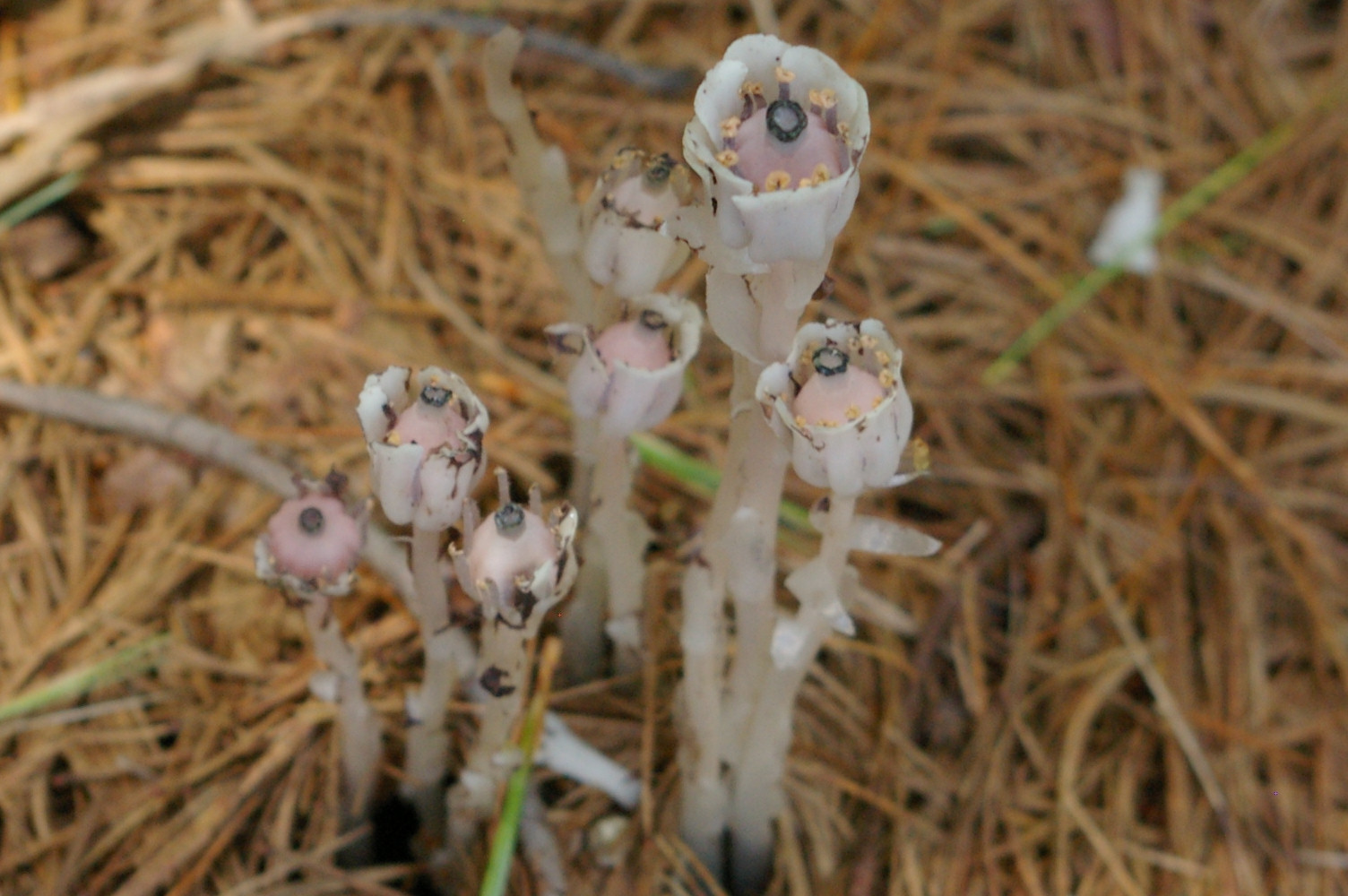
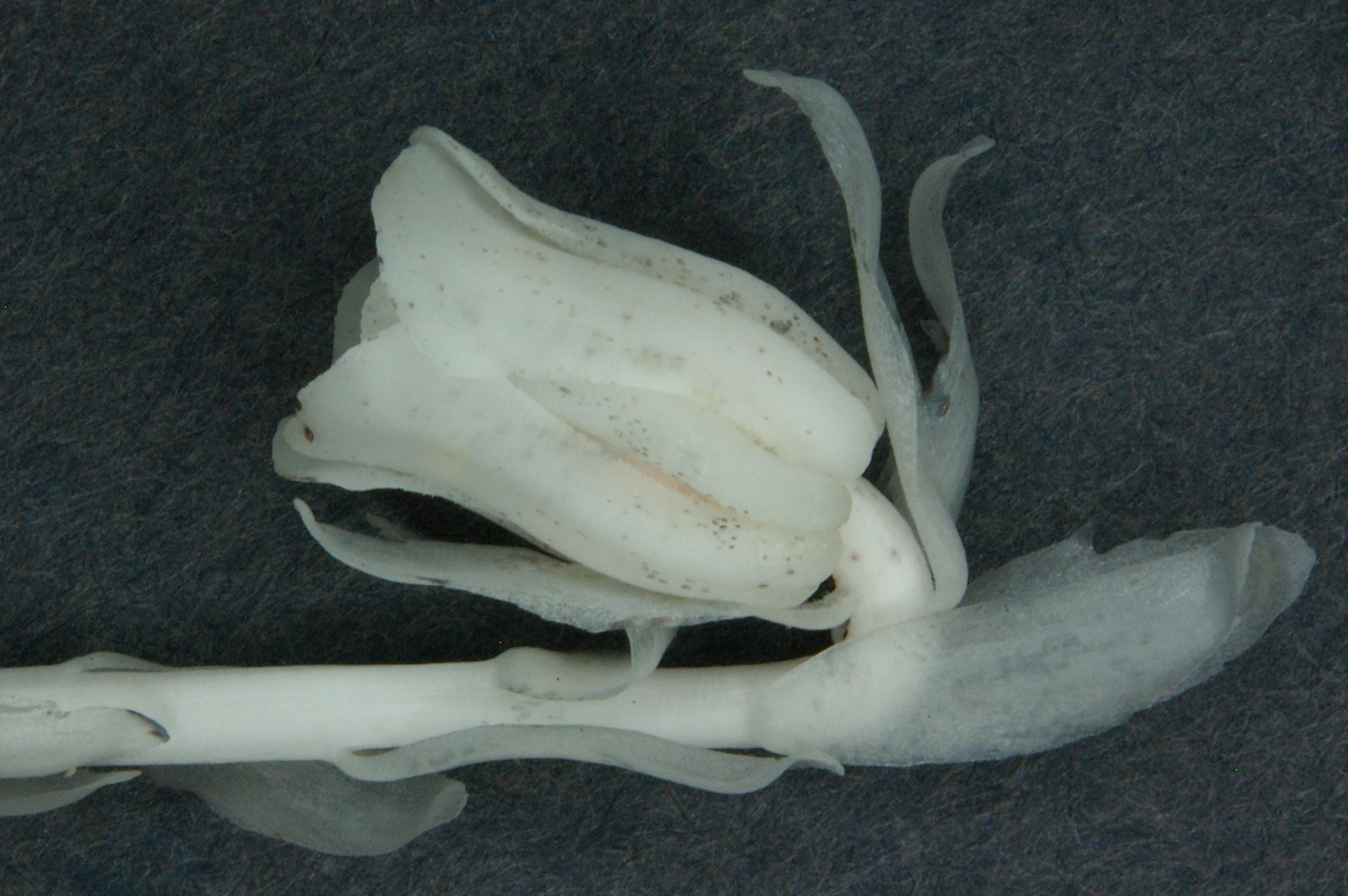
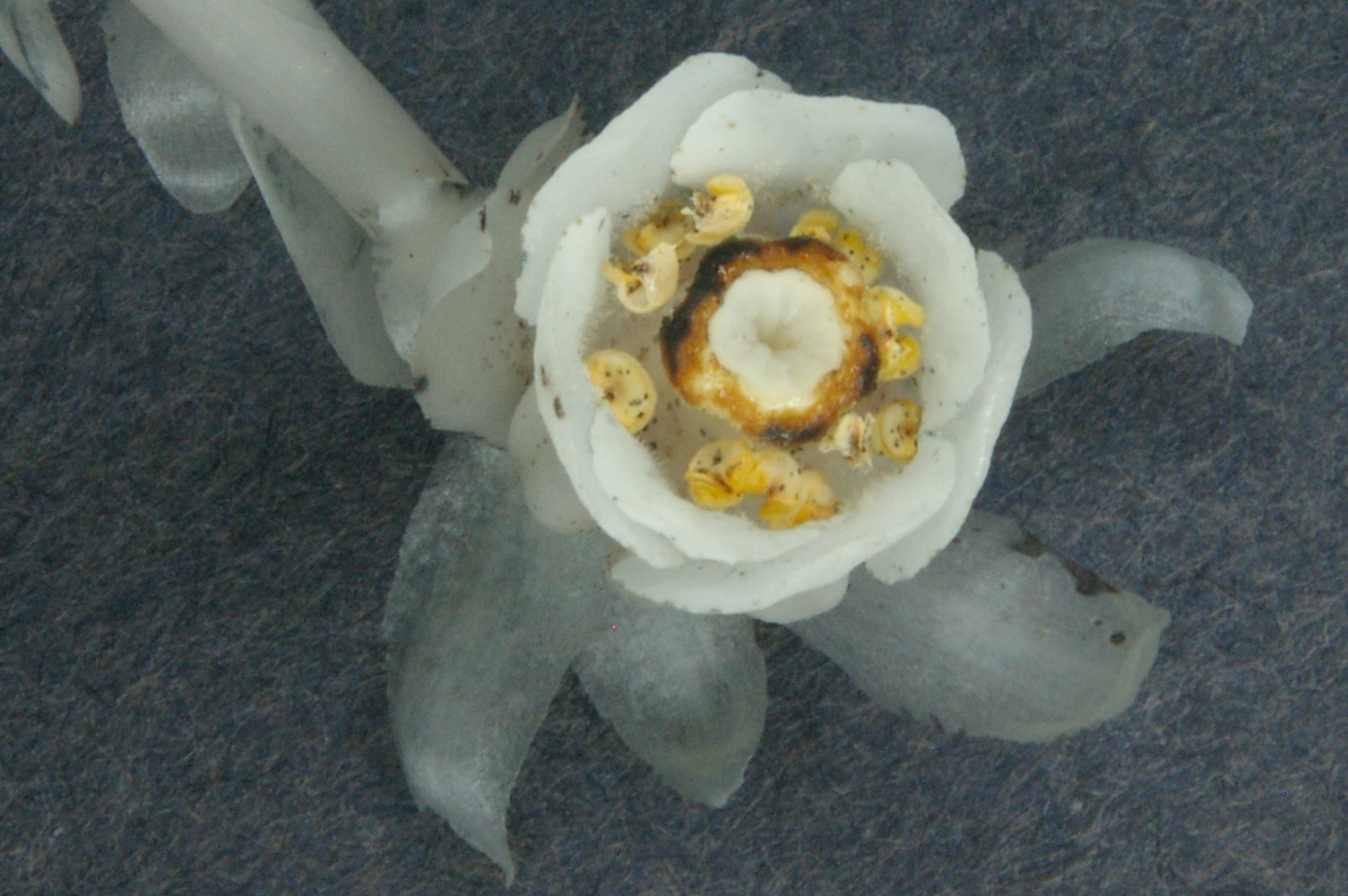
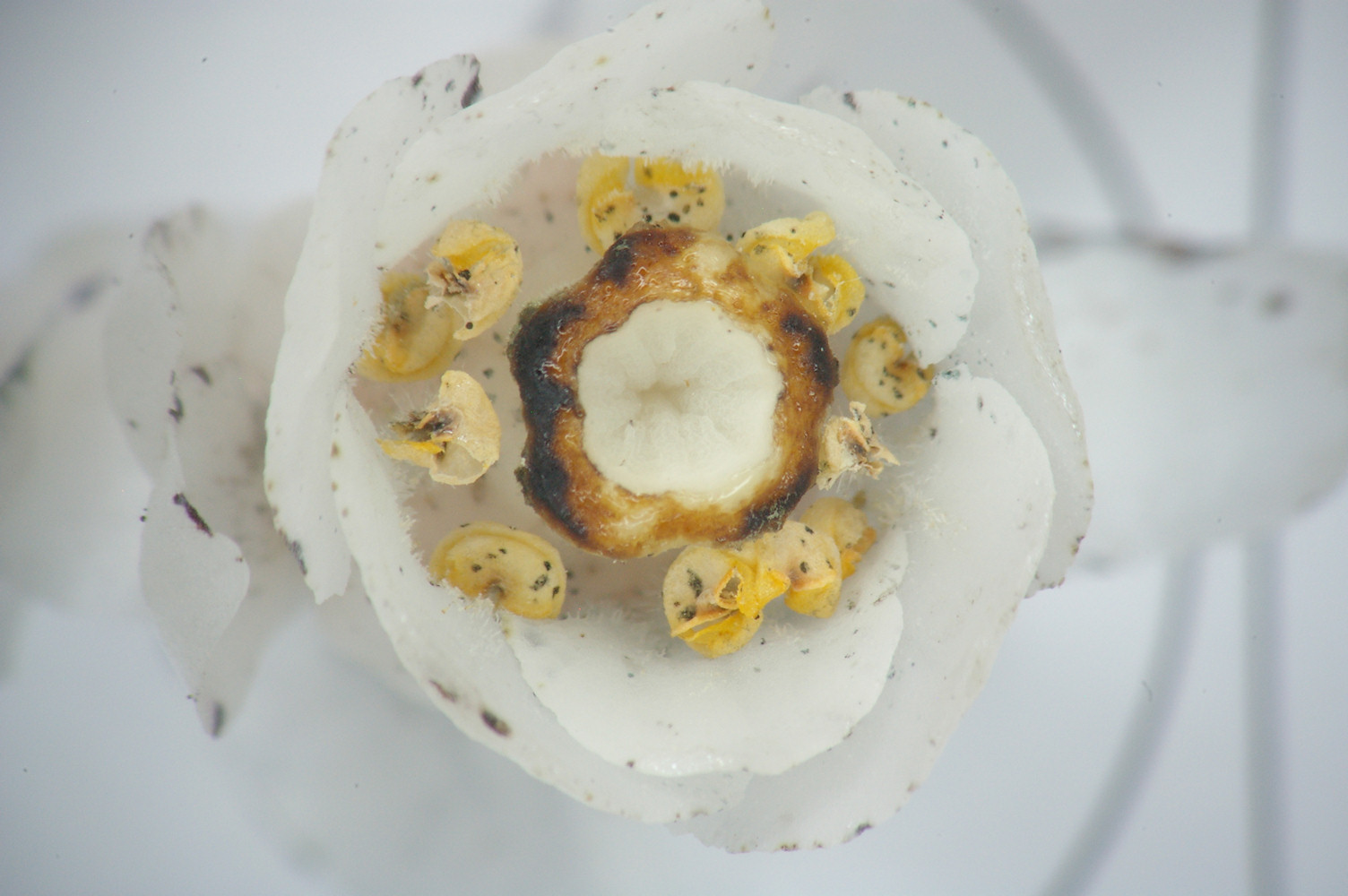
Normally I try to avoid disturbing native plants growing wild but, since my sister had never seen an Indian Pipe before and there where so many on our land, I picked one for her. After she’d examined it I put it in the fridge so that once I was done with work for the day I could take some macro and micro photographs.


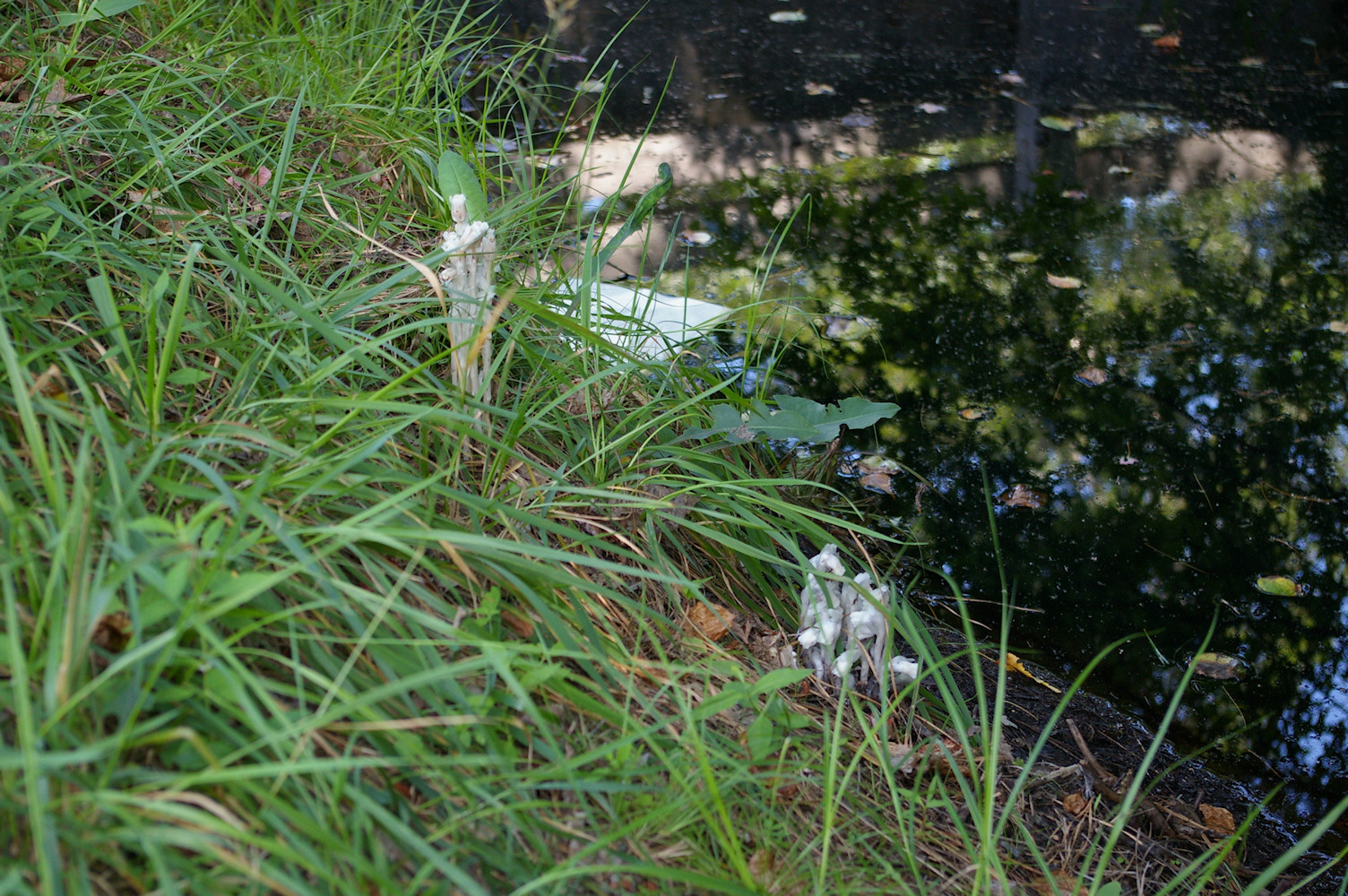
Whenever I’ve seen Indian Pipes it has been in forest areas so I was very surprised to see two clumps of Indian Pipes growing on the grassy bank of a drainage ditch in front of my employers factory a few days later.

There are more photographs in my online photo album.
I had never seen these odd flowers growing through grass before, this had to be an extraordinary year for Indian Pipes. Witnessing this population explosion of a normally rare flower I wondered why it had happened. Being a native plant I figured the most likely cause was an increase in their food supply. Since we had experienced above average rainfall and below average temperatures in June and July I thought that was a probable cause.
Pondering my hypothesis, it didn’t hold water given my knowledge of this plants nature. Forty years ago I was taught that these flowering plants with no chlorophyll couldn’t use the sun like green plants so they fed on decaying leaf litter. To speed the rate of decay you want to increase both moisture and temperature so, while the extra rain would help the lower temperatures wouldn’t.
This led me to start searching for more information on this flower, my first stop for information on flowers of southern New England is usually the Connecticut Botanical Society. As usual I found a good summary page there with the scientific name to help me find further sources and the following description.
Indian pipe, like its relative pinesap, has no chlorophyll, so it cannot obtain energy from sunlight. Instead, it gets nutrients from organic matter in the soil.
This confirmed what I had learned decades ago so I was still puzzled why there was a population explosion. Researching further (see resources list at the end of the article for links) I found out that I and the CBS website had obsolete information. Scientists have shown that Indian Pipe does not get its nourishment from decaying material, it’s a parasitic plant! Monotropa uniflora is a parasite of fungi that are mycorrhizal symbionts of trees so, increasing rate of decay in the leaf litter wouldn’t likely be a factor at all. The unusual weather in June and July likely caused the fungi and its associated tree(s) to generate a larger than normal food supply giving this parasitic flower an advantage.
Reading through all the information I’d found led me to another mystery. Some of the sources imply or outright state that the tree involved in the relationship is a always conifer. The Indian Pipes in my yard where near pine trees and my memory is that whenever I’d seen them other places in the past there were conifers nearby. However, most of my nature explorations have been in southern New England and almost everywhere is mixed deciduous and conifer forest. So having conifers nearby is really just a default condition and not necessarily linked to the Indian Pipes.
Thinking back on the flowers I found near the drainage ditch, they were on the other side of the drainage ditch from the conifers in the area. Since the ditch is four feet wide and four feet deep it seemed unlikely that the fungus was going down over four feet through the sand and gravel base of the ditch to reach pine trees. There is only one tree on the flowers side of the ditch, a sapling oak tree a few feet away from the flowers. So I hit the resources again for more in depth reading and found that the conifer association is not stated as a requirement in the more thorough references. I suspect the little clusters by the drainage ditch are parasites of a fungus attached to that little oak tree.
With all the references I’ve studied I learned something that leads to another puzzle. The mushroom I saw around the Pipes in the back yard is very likely to be from the fungus it is parasitizing. Also a number of studies have shown that Monotropa uniflora associates with quite a few different fungi but they are all of the family Russulaceae. My mushroom identification was in the Tricholomataceae family which doesn’t fit with the literature I’ve read.
To solve the puzzle I came up with a list of possible solutions:
- I misidentified the mushroom.
- The mushroom is not from the fungi associated with the flowers.
- The literature is incomplete, Monotropa uniflora can associate with fungi of the Tricholomataceae family.
Applying the basics of Occam’s razor, solution 3 drops off first, multiple studies have shown Indian Pipes only associated with family Russulaceae. This leaves one and two to consider, given that I saw no other mushrooms in that area this summer that leaves number one as the most plausible solution. Big surprise, Not! Even experts have a hard time identifying mushrooms which is why I would never trust my identification and eat a mushroom I found and identified.
Monotropa uniflora Resources:
Wikipedia
USDA PLANTS Profile
Tom Volk’s Fungus of the Month for October 2002
Botanical Society of America Parasitic Plants Online
Native Plant Information Network @ the Lady Bird Johnson Wildflower Center

 Paul Hutchinson's Blog