This little Black Capped Chickadee at first doesn’t notice the lawn tiger peeking out below the lower rail in the deck corner.
But that doesn’t last long, lawn tiger is foiled again, better go back to hunting chipmunks.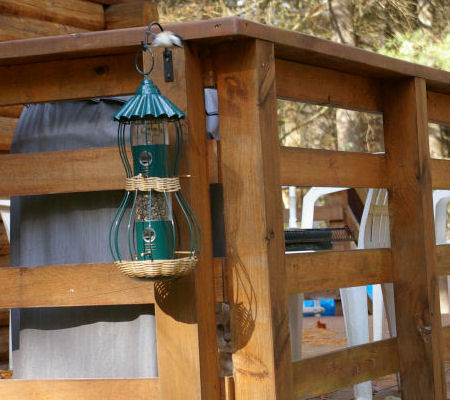
News & Views from an Embedded Systems Designer
General rambling, ranting, raving etc.
This little Black Capped Chickadee at first doesn’t notice the lawn tiger peeking out below the lower rail in the deck corner.
But that doesn’t last long, lawn tiger is foiled again, better go back to hunting chipmunks.
OK, what are you waiting for? Get your butt over to Stranger Fruit and click the “donate to my challenge” button on the left just below John’s picture.
I finally got my year end profit sharing check so I made my donation tonight. If you don’t know about DonorsChoose, see my other post on this fine organization or check out John’s posts about the organization and the ScienceBlogs challenges. The challenge ends this month so GO TO Stranger Fruit AND HELP US GET TO THE GOAL, NOW!
P.S. If you stumble on this post after the challenge ends, simply go to DonorsChoose and pick a project yourself.
Recently a case involving software licensing and copyright was discussed on an engineering list. Reading the discussion it became clear to me that it is likely that a majority of people don’t know how copyright and licensing go together. So I thought I’d write a brief primer on the basics of copyright in the 21st century. The particular case in that article illustrates how the wrong choice of license can lead to the loss of some rights that the copyright holder did not intend.
But I’m getting way ahead of myself here, let me start with the basics. First a disclaimer, I am absolutely, positively, not a lawyer. If you have any doubt about any copyright issue that could cost you money consult a copyright lawyer. Second point, I only know about US copyrights, the copyright laws in other countries may be very different. Final point, in this post I’ll be using the terms work and works to indicate any writing, painting, photo, video, music, graphics, software and other types of creative output that is protected by copyright law.
For readers closing in on 50 years old like me or, already past it, I’ll start with how it was before 1978. When I first learned about it the law of the USA was the Copyright Act of 1909. This law specified that copyright was something you had to intentionally place on works if you wanted protection. If you distributed a work without attaching a copyright notice and filing for copyright protection the work was considered public domain. With the adoption of the 1976 Copyright Act, which went into effect in 1978, this situation was reversed. Since 1978 any work a person creates receives full copyright protection immediately without any filing or adding of notices. This means that even a finger paint drawing a three year old creates is automatically protected as a copyrighted work of the three year old the moment it is created.
This gives us the two ends of the copyright spectrum, fully protected and public domain. Public domain works can be used in any way by any person with no restrictions. This means that if someone wants to they can take your public domain work and sell it for money without giving you any credit or money. Full copyright protection prevents everyone from doing almost anything with the work unless they previously were granted permission by the works creator. There is an exception to this known as “fair use” that does give some limited usage rights to critics, reviewers, buyers of the work and others. Fair use is a complicated topic that I don’t have time to cover in this post, see the Wikipedia article for more information.
Often the two ends of the spectrum don’t provide a content creator with a usable option. Putting your work in the public domain makes it difficult to earn a living from your works. Enforcing full copyright on your work severely limits your distribution options because you need to individually grant rights to your customers. When you want to retain control of your works but not burden yourself and your customers with individually granting rights, the solution is to apply a license to the work.
A license for a copyrighted work is a way to take some rights away from the copyright holder and give those rights to the customer. An example of a right most software companies and developers want to give their customers is the right to make archival copies for backup purposes. Without a license granting this right it could be a violation of copyright law for your customer to make a backup copy of the CD you gave them when you sold them the software. (Note fair use doctrine may give some archiving rights to the customer)
You should put a good deal of thought into choosing a license for your works because the wrong license could turn into a big problem. You can create your own license with the help of a copyright lawyer and this is what big businesses usually do. However the costs can be large and if there is a mistake in the license you could lose some of the rights you meant to retain. So, for individuals and small businesses the best solution may be one of the pre-made licenses that are freely available. The Free Software Foundation created and maintains the GNU General Public License (GPL) for software. While this is an excellent license created by some great legal minds it is very restrictive and may not be what you want. So other licenses have been developed such as the LGPL, BSD, Apache and others. For non-software works until recently there were not many choices other than full protection and public domain release. Thankfully the Center for the Public Domain recognized this need and has created the Creative Commons licenses for non-software works.
For more information see:
U.S. Copyright Office
Copyright Law
A brief intro to copyright
10 Big Myths about copyright explained
Ahoy! buckos, today be Talk Like A Pirate Day. Visit t’ official web site for details.
Aarrr!!
Tonight’s News Hour on PBS had an interview with Andrew Keen, author of “The Cult of the Amateur: How Today’s Internet Is Killing Our Culture”. He comes across as someone I would never want to talk to or read anything he’s written. Basically he looks and sounds like a grumpy old man screaming “Hey you kids, get off of my lawn”.
More info on Keen and his book:
Keen’s “The Cult of the Amateur”: BRILLIANT! (Lessig Blog)
EdCone.com: Not so keen
commonground : Blogs Suck, Who Cares?
EvolutionBlog : The Importance of Bloggers
PZ posted this morning about an organization that sounds great, DonorsChoose.org. From the home page:
DonorsChoose is a simple way to provide students in need with resources that our public schools often lack.
Here, teachers submit ideas for materials or experiences that their students need to learn. Individuals like you can choose a project and make it a classroom reality.
Dr. Free-Ride (Janet D. Stemwedel) has a blog post, Finding cash to make learning happen, that gives a more detailed summary and some good pointers for teachers.
If you live near a needy school, volunteering your time to the school is great way to help out but, if like me you don’t live near enough or have the free time to volunteer then DonorsChoose.org lets us help out via the internet.
I’ve finished the upgrade and it seems to be working OK. If anyone spots a problem please leave me a comment so I can fix it ASAP.
I’m trying to get this blog updated to a new version of WordPress. It may not be fully functional for a few days. 😦
I received the following attempt to comment spam this blog today:
Author : galinagirll (IP: 72.9.235.218 , server6.barronhosting.com)
E-mail : tesrghft8077@inbox.ru
URI : http://love.com
Comment:
hello , you have a very nice site, but Im hired to leave advertising comments on sites, sorry i hate to do it but i have to . If you dont like advertising comments please send me an email with your site address to tedirectory(at)yahoo(dot)com and I will not write on your site. Sorry for inconvenience.
The URI link, love.com, returns this WhoIs info:
Domain Name: love.com
Registrant:
AOL LLC
22000 AOL Way
Dulles, VA 20166
US
The domain redirects to AOL personals so, the polite comment spammer sure seems to be working for AOL. Is AOL really stooping this low, hiring spammers to get better Google rankings?
IMHO, the Associated Press has a better article about a Grim Reaper cat than the New England Journal of Medicine. 😦
Read the articles for yourself and see which one you think is better.
AP – Oscar the cat predicts patients’ deaths
NEJM – A Day in the Life of Oscar the Cat
PS – The cat should have been named Rube instead of Oscar.
 Paul Hutchinson's Blog