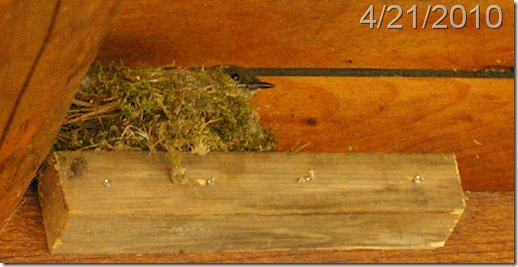
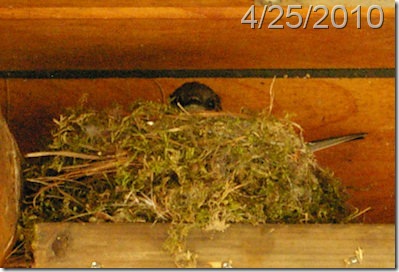
At the end of April I posted about the Phoebe nest on my porch. I got a better look at the clutch of eggs and noticed that one of the five had dark spots. Over the next two weeks the dark spots increased so I figured one egg was bad. On May 11th I spotted the first hatchling and by the 15th there were four hatchlings in the nest (my guess was right, one bad egg).
Originally I had just lashed a cheap magnifying hand mirror from a dollar store to my monopod so I could look in the nest without getting to close. This arrangement was a bit tricky to use because the loose lashings made it difficult to get the mirror into position between the nest and the porch roof. To give me a better tool for checking the nest I drilled a 1/4 inch hole in the plastic surround of the mirror and used a nut to attach it firmly to the monopod’s head. My monopod is a very sturdy 1970’s vintage, ball & socket head unit, with four telescoping sections. With the easy mirror install/removal using a 1/4-20 nut and 5 foot reach I now have a nice portable tool for inspecting bird nests in the field as well as at home.
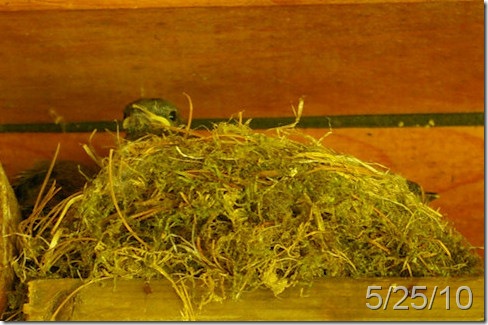
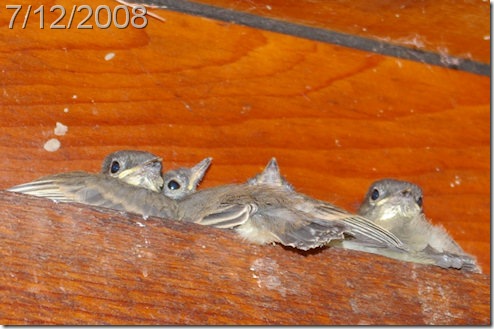
By May 25th the chicks were regularly popping their heads up and the porch ceiling is very close to the nest so, I stopped using the mirror to examine them as I didn’t want to accidentally touch them with the mirror. I tried to get a good head count when they where awake and peering out of the nest but I never saw more than three chicks. I kept my fingers crossed that I was just unlucky to not see all four but as time went on it became clear that one of the four chicks hadn’t survived the ten days since I’d last observed them with the mirror. I really shouldn’t have been surprised since the last time Phoebes nested here in 2008, only three chicks survived to fledge in the first brood. The following picture shows two of the three chicks.
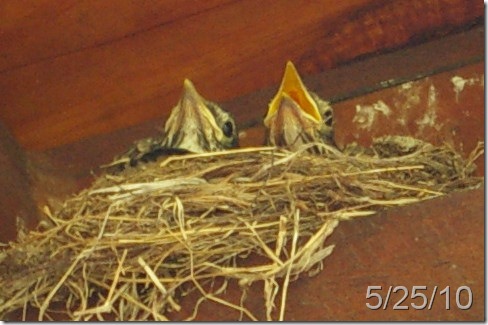
At the other end of my house my brother had found the remains of an American Robin egg (Turdus migratorius) when he was visiting on May 22nd. The Robins nest is on a small ledge at the eaves of the log cabin about 14 feet above the ground and right where the overhead power wires come to the building. Between the height and the proximity of the wires I didn’t dare try to get a look in the nest with my mirror on a metal pole. I would look from the ground every time I passed by but couldn’t tell how the Robin’s brood was doing. Momma Robin is very skittish, she takes flight when ever anyone passes by the nest so I tried to avoid the area as much as possible. Finally on the 25th when I passed by the nest I saw these two chicks in the nest.
The next day I noticed that the side of the Robin’s nest was broken open with two chicks in the nest and one chick on the ground underneath a nearby azalea bush. Watching from a distance during the day I saw the chick wander into the woods near that end of the house. The next afternoon when I checked the other two chicks had left the nest and the adult Robins where busily catching food on the lawn and bringing it into the woods for the chicks.
On Thursday that week I got this good photo of two of the Phoebe chicks who looked ready to fledge.
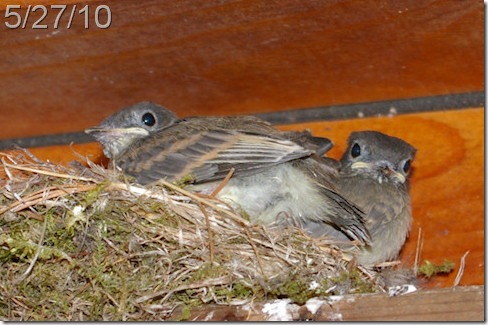
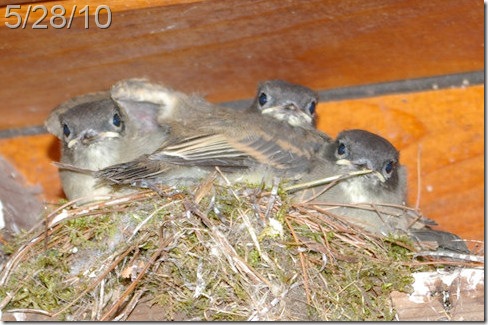
The next evening Friday May 28th when I got home from work all three chicks were up and looking ready to go. I grabbed my camera to get the shot below, I guess they were really ready to fledge because as soon as the flash went off all three flew away from the nest and out into the woods.
Over the next two weeks I saw Momma Phoebe fixing up the nest and by June 11th she was back incubating her next clutch. Not wanting to disturb her I again waited for a time when she was off feeding and finally on the 14th I saw five eggs in her new clutch. This time all five eggs looked normal so I had high hopes for a bigger brood this time.
On Saturday June 26th I counted three for certain and likely four Phoebe hatchlings so I was hoping that I’d have a repeat of 2008 when four chicks fledged from the second brood. Sadly this was not to be the case, between July 4th and 9th we had an unusual early heat wave. While the daily highs were not that much higher than a small heat wave we’d had in May, you can see in this graph that the average temperature was far higher.
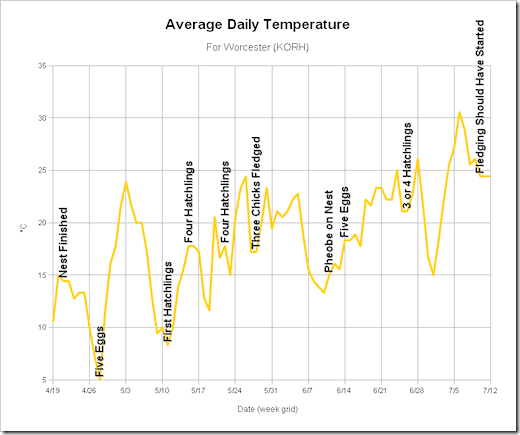
On July 7th we found one dead Phoebe chick on the porch below the nest. The Adults were still making regular trips to the nest but by the 9th they stopped coming to the nest. Sadly it seems the heat wave killed all four chicks. With the position of the nest so close to the porch ceiling there is not much airflow around it leaving the poor chicks in very hot stagnant air. Next year if the Phoebes come back and we get an early heat wave I think I’ll try to get a fan out on the porch to see if I can give them a better chance at survival.
While it was sad to witness the deaths of our cute little Phoebe friends I was consoled by the fact that the Robins had already successfully raised two broods and Momma Robin was already incubating her third brood.
This past Sunday afternoon there was an unexpected knock on the door. When I answered it a woman was there holding a Robin chick in her hand. She was driving by and saw the chick by the side of the road with both parents watching after it trying to keep it off the road. I showed her the Robin nest on the side of our house and had her set the chick down on the grass next to the azalea bush below the nest. I figured it was very likely that chick had come from our nest and that the adults would come take care of the chick.
Over the next half hour I observed the adults going to the nest but I never saw them on the ground by the rescued chick. So I had my sister watch for the parents while I went to the shed to get a ladder. When I got back with the ladder my sister told me the parents hadn’t come to the chick on the ground. So I set up the ladder, picked up the chick and carried him back up to the nest. As soon as I set it down by its two siblings it jumped right back off and down to the ground. Clearly the chick did not want to be near that nest.
We noticed that the chick seemed to be exhausted so my sister set a pan of water out in case he would drink. The little guy didn’t move so she took a little piece of bread, dipped it in the water and offered it to the chick. As soon as the chick sensed the wet bread it opened wide and my sister dropped the bread in his mouth. She soaked another small piece and as soon as her hand moved near the chick it opened wide, that chick was no fool it caught on quick that her hand meant wet food. She gave it another piece or two and then we left the area in the hope that the adults would come take care of it.
There was a good possibility that this chick was not from our nest so we decided we’d check every 30 minutes to see if the chick was OK. The next time I went to check the chick was gone, searching around the yard I spotted it sitting atop a small rock on the edge of the woods half way from the nest to the street. I watched it from a distance for a while until finally one of the adults came over to the rock and fed the chick. I checked again about a half hour later and saw the other adult come feed it some more. This was a relief because while I’m certain there are many other Robin nests in our area I didn’t know exactly were they are located so I wouldn’t know were else to put the little guy.
The next morning I went to check up on him and I couldn’t spot him anywhere in the yard. So I sat on the edge of the porch for a while and listened, sure enough I heard the chicks up in the nest calling for food and I heard what must be the the rescued chick calling from the woods near the nest. Today I looked at the nest with binoculars to see if the siblings had left the nest. It appears they have both left and are probably with the other chick hanging out in the woods being looked after by their parents and learning how to fly and find food for themselves.
A nice happy ending but today I did a little reading up on American Robins and found that the future isn’t so bright for these individuals. Only one in four Robins who hatch will survive past November and for adults the average life span is a short two years. Considering these members of the thrush family hunt on the ground and are large enough to be easily seem from a distance it shouldn’t be surprising that they die young from predators. With the young ones spending so much time on and near the ground before they can competently fly it makes sense that the chicks would have a high mortality rate. I guess that explains why the adults are so wary and why they have three broods per season, more than most of our other local bird species.


 Here’s how I did it, first you get the ID for the playlist. Click the grid view icon in the upper right then click the playlist you want to watch. This will give you the playlist URL like this:
  For the example I’m using, the resulting URL is:

 Today is the 4th annual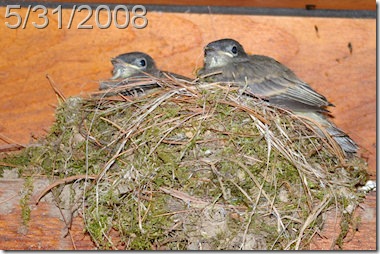
 Paul Hutchinson's Blog